Copart Shipping Cost: How to Estimate Transport Before You Bid
In this article (9 sections)
Shipping is the cost layer most Copart buyers either over- or under-estimate. Over-estimate and you walk away from deals that would have penciled. Under-estimate and you win a bid you cannot actually deliver to your shop profitably.
This guide gives you real 2026 ranges for Copart transport — what to expect, what drives the price, and how to book without leaving money on the table.
LocalIQ™ market snapshot
What top flip candidates are asking right now
| Model | Listings | Median asking price |
|---|---|---|
| GMC Sierra 1500 | 523 | $29,995 |
| Chevrolet Silverado 1500 | 1,367 | $25,000 |
| Toyota Tacoma | 1,164 | $27,516 |
| Ford F-150 | 2,592 | $23,995 |
| Ram 1500 | 992 | $22,900 |
| Ford Mustang | 571 | $20,995 |
| Jeep Wrangler | 548 | $25,089 |
| Chevrolet 1500 | 539 | $20,900 |
LocalIQ™ asking-price median · 8,296 listings · updated every 6 hours. National, last 8 model years; asking price is your resale ceiling, not a promised sale price.
The Three Variables That Set the Price
Shipping cost is driven by three things:
- Distance between the Copart yard and your destination
- Carrier type — open vs enclosed
- Vehicle condition — operable vs inoperable, oversized, salvage, etc.
A 200-mile open-carrier shipment of a running sedan is the cheapest scenario. A 1,500-mile enclosed-carrier shipment of a non-running pickup with airbags deployed is the most expensive.
Open Carrier Rates by Distance (2026)
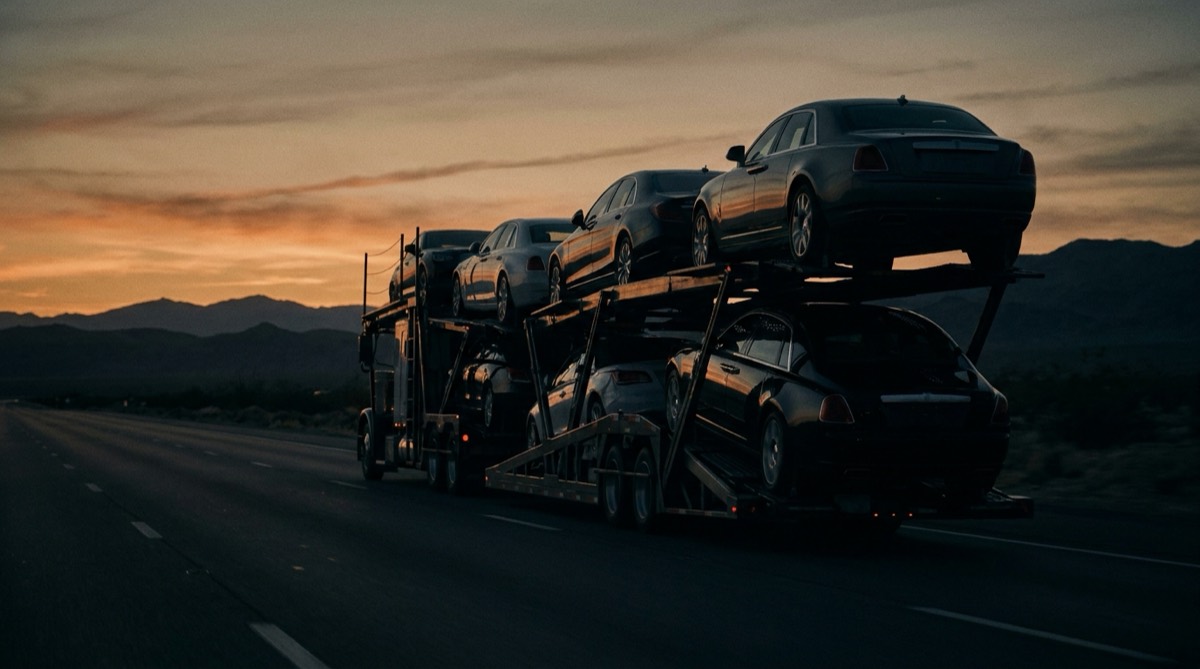
Open carriers are the default for almost all Copart shipments. The car rides on an exposed multi-vehicle trailer. Industry-standard for any non-exotic vehicle.
| Distance | Typical Cost (2026) |
|---|---|
| Under 100 miles | $200 – $400 |
| 100 – 300 miles | $350 – $600 |
| 300 – 600 miles | $500 – $900 |
| 600 – 1,000 miles | $800 – $1,200 |
| 1,000 – 1,500 miles | $1,000 – $1,400 |
| 1,500 – 2,500 miles | $1,300 – $1,800 |
| Coast-to-coast (2,500+) | $1,500 – $2,200 |
These ranges assume operable, drivable vehicles. Adjust upward for the variables below.
Enclosed Carrier Rates
Enclosed carriers protect the vehicle from weather, road debris, and prying eyes. They cost roughly 1.8x to 2.2x the equivalent open-carrier rate. Use enclosed only when the car's resale value justifies it — typically $40,000+ vehicles, exotics, or collectibles. For a normal flip car, enclosed is overkill.
Surcharges That Inflate the Quote
Five common reasons your initial quote climbs:
1. Inoperable Vehicle (+$100 – $250)
If the car will not start, will not roll, or has flat tires, the transporter needs a winch or forklift. Most carriers charge $100-$250 extra. Copart marks operability on the lot detail page — verify before bidding.
2. Oversized / Heavy Vehicle (+$50 – $300)
Full-size trucks, SUVs, vans, and anything over ~5,500 lbs take up more deck space. Carriers price by deck position, so a Tahoe costs more than a Civic over the same route.
3. Convertible or Low-Clearance (+$50 – $150)
Roof down or ground clearance issues require careful loading. Most carriers add a modest premium.
4. Hazmat / Airbag Deployed (+$50 – $200)
Deployed airbags trigger hazardous materials handling. Some carriers will not take cars with deployed airbags at all; the ones that will charge extra.
5. Out-of-the-Way Yard (+$50 – $300)
Copart has 200+ yards. The popular ones (Charlotte, Houston, Atlanta, Phoenix, Sacramento) get great rates because carriers run those routes constantly. Rural or low-volume yards (parts of Wyoming, Idaho, Vermont) cost more because carriers have to deadhead in.
Where to Get Transport Quotes
Two reliable approaches:
Broker route (easiest)
Use a broker like uShip, Montway, or Sherpa Auto Transport. You post the lot, brokers bid, you pick the lowest reasonable quote. Quotes typically come within hours.
Pros: zero work, competitive prices. Cons: brokers take a cut, response times to issues can be slow.
Direct carrier route (cheapest)
Find a regional carrier that runs your route regularly. Call directly. Negotiate. Pay them directly.
Pros: ~10-20% cheaper than broker quotes. Cons: requires relationship building and your own dispatch.
For new flippers, broker is fine. For high-volume operators, direct carrier saves real money.
When to Book
Book transport before the auction closes, with a hold contingent on winning the bid. Why:
- Storage starts on day 4. $30/day adds up fast.
- Carriers fill up. A great route quote becomes a mediocre one if you wait three days.
- Your time has value. Booking after winning is mental overhead you do not need.
Most brokers and direct carriers will hold a quote for 48-72 hours pending auction outcome at no charge.
How Transport Cost Affects Your Max Bid
A $700 transport cost reduces your max bid by exactly $700, assuming all other variables stay constant. On a deal with a $1,500 target profit, that is 47% of your margin.
This is why bidding without confirming transport in advance is a margin-killer. A car that pencils at $400 transport (close yard, popular route) might not pencil at $900 transport (rural yard, deadhead route).
The Copart Fee Calculator has a transport input in Max Safe Bid mode — plug your real quote in before deciding your max.
Don't guess transport. Plug in your real quote.
Open the calculatorSpecialty Cases
Driving It Home Yourself
For local pickups (under 200 miles) of operable, road-legal cars, driving home can be cheaper than hiring transport. Factor in:
- Fuel ($30-$50 for most sedans under 200 miles)
- Your time (4-8 hours including pickup)
- A second person to follow in your car
- Risk if the vehicle has unknown mechanical issues
Most Copart cars do NOT have valid registration or current plates. Driving on a dealer plate or one-trip permit is legal in most states but verify before relying on it. Branded titles (salvage) typically cannot be driven on public roads at all without re-titling.
Long-Distance Driveaway
Hiring a contract driver to drive the car to you is rare but available. Cost is comparable to enclosed transport for distances under 800 miles. Useful for collectibles where you do not trust a multi-vehicle carrier.
Container Shipping (Export)
If you are exporting (common for high-CC engines headed to Africa, Caribbean, Central America), the car goes into a container at a coastal port. Container costs ($1,200-$2,500 per car shared, $3,500-$6,000 per car solo) plus port handling are separate from domestic transport to the port.
Most retail flippers do not export. If you do, your transport math is different — see specialty export forums.
Bottom Line
Copart transport in 2026 ranges from $200 (short, local, easy) to $2,200+ (cross-country, oversized, inoperable). For most flippers buying within 600 miles of a major yard, budget $500-$900 per car as a starting estimate, then get a real quote before the auction closes.
Plug your real transport quote into the Copart Fee Calculator to see how it affects your max bid. And remember — every dollar of transport is a dollar off your profit. Choose nearby yards when you have a choice.
Know the full landed cost before you bid.
CarFlipIQ pairs free auction calculators with real local resale data across all 50 states.
Frequently Asked Questions
How much does it cost to ship a car from Copart?
Usually $150-$600 depending on distance and whether the car rolls or needs a winch (non-runners and all-wheel-drive cost more). Always get a quote before bidding - it's a real line item against your margin.
Can I estimate Copart transport before I bid?
Yes, and you should. Get a shipping quote for the lot's yard to your location and add it to fees and taxes before setting your max bid - surprise transport costs are a common way flips lose money.
Does Copart arrange shipping?
Copart offers transport options, but third-party carriers are often cheaper. Either way, lock in the cost before you bid so your max-bid math reflects the true delivered price.
How we get these numbers
Market figures come from LocalIQ™, CarFlipIQ's index of asking prices on local used-car listings. We report medians rather than averages, so a few outlier listings can't drag the number, and a model only appears once it has at least 10 listings behind it. Asking prices tell you what the market is asking, not what a car will sell for — treat them as your resale ceiling.
Copart fees + local resale prices by city
Check the resale before you bid
Look up any year, make and model against LocalIQ™ asking prices in your market. 5 free car analyses, no credit card.